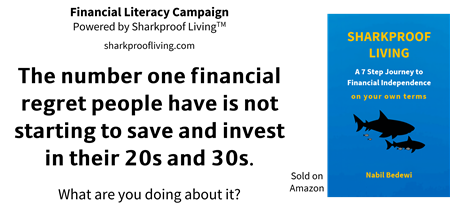
Sharkproof Living (SPL) has begun donating the book “Sharkproof Living: A 7 Step Journey to Financial Independence on your own terms” to nonprofits. This effort is part of the Financial Literacy Campaign and addresses the number one financial regret people have, namely, not starting to save and invest in their 20s and 30s. At $3, the eBook serves as a low-cost, high impact option for people to begin their financial literacy journey.
About the Book
When you hear the word ‘financial independence’, it’s easy to think that’s something for other people, right? You’re not good at saving. You run away from the word investing. And you don’t have the attention span for numbers and spreadsheets that take over your life.
Sharkproof Living: A 7 Step Journey to Financial Independence on your own terms makes creating financial priorities easy, giving you the complete system you need to be smart in a world where sharks hold the key to most of the world’s financial success.
This book walks you through these Steps:
-
Commit to Investing
-
Set Your Financial Priorities
-
Love, Hate, and Prune Your Expenses
-
Get Adequate Insurance
-
Set Up the Right Accounts
-
Make Good Investment Decisions
-
Monitor Your Progress and Complexity
Each Step’s chapter includes the following sections:
- Opening Metaphor Story
- Personal Reflections
- What Makes the Step Complex
- A set of Frequently Asked Questions (FAQs) to break down the complexity
- A Sharkscam list of common scams that raise awareness and encourage you to search further for specifics
- System Update to help you refine your system
- Time for Your Action!—where you implement what you’ve learned in the Step as it applies to your situation
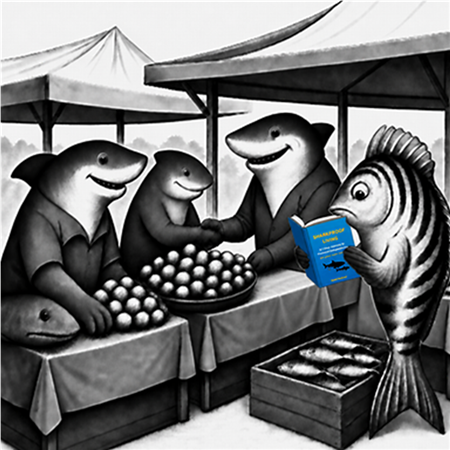
You, as the pilot fish, will learn to juggle different sharks, whenever needed, to your financial advantage.
It’s time to stop treating financial independence as a complicated, scary deep ocean and learn what the sharks know– implementing simple steps to take control of your financial future.
A note to non-USA readers
Some examples refer to U.S. institutions, financial options, and tax laws. If you live elsewhere, the same principles still apply—you’ll just need to look up your local equivalents.
About the Author
The author, Nabil Bedewi, retired at 49 with a 7-figure net worth after starting his career in 1982 making ~$17,000 a year as a junior engineer. His approach to financial independence isn’t glamorous or high-risk. It’s actions that every salaried person can put into place to reach their financial goals on their timeline.
He wrote Sharkproof Living™ because he’s seen adults, specifically young adults, follow the wrong financial advice in pursuit of financial independence, simply because it’s what trendy influencers are saying.
He created an easy-to-follow system, so even the least numbers-savvy person can reach their financial goals through easy, consistent investing and financial goal setting. Written as 7 Steps, even the most math-resistant brain can start to set themselves up for success and know how to navigate with the sharks around them. Learn more about Nabil's background.
The number one financial regret people have is not starting to save and invest in their 20s and 30s. We can all play a role in changing this.
Across the U.S., thousands of commencement ceremonies take place every May as nearly four million students graduate. As a student and later as a professor, I sat through more of them than I can count. One universal ritual: everyone gets subjected to speakers of wildly varying quality, and most of what they say evaporates from memory before the chairs are even folded.
So if I were giving a commencement speech today, here’s what it would be.

When I retired at 49, people kept asking me to write a book explaining how I did it. It took me fifteen years to write about my journey of choices, mistakes, and adjustments, but that’s for future blogs.
This post is about how we achieve Financial Independence (FI), but first I want to start with a story.
Does the world really need another personal finance book? A fair question, and one I’ve asked myself more than once.
Here’s the thing: Some books teach a lot, but when the last page turns, you’re left asking, “How do I apply this to my situation?” This book is built to answer that.